
oPod™ Aqua
Desalination Without Coastal Infrastructure
Offshore desalination.
Deployed in weeks.
Scaled without infrastructure.
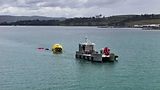
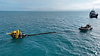
The oPod™ Aqua DOD is a modular offshore desalination platform designed to deliver reliable freshwater production without grid power or complex coastal infrastructure. By leveraging wave and renewable energy, oPod™ Aqua significantly reduces energy demand and enables rapid deployment in remote and infrastructure-constrained environments.
The oPod™ Aqua DOD is a modular offshore desalination platform designed to deliver reliable freshwater production without grid power or complex coastal infrastructure.
By leveraging wave and renewable energy, oPod™ Aqua significantly reduces energy demand and enables rapid deployment in remote and infrastructure-constrained environments.

System Overview

Typical footprint:
~4.5 m x 4.5 m
Typical total height:
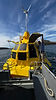
~25 m (including~20m submerged intake)
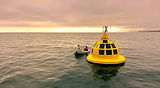
Fully integrated floating system
Fully integrated floating system (energy, desalination, storage)
Configurable for site conditions
Intake depth and system geometry adapted to water depth, bathymetry, and distance from shore
Designed for integration
Compatible with pipeline delivery to shore or connection into existing water infrastructure

Production: ~20-25 m³/
day per unit

Deployment: ~12 weeks
(manufacture to installation)

Energy: Fully offshore. no
grid connection required

Scaling: Linear and predictable
through modular deployment
Why It Matters
-
Simplified marine infrastructure
No intake or brine discharge systems, reducing permitting complexity, cost, and construction scope -
Lower energy demand
Wave-assisted intake and pre-pressurisation reduce operational energy requirements -
Reduced operational risk
Distributed systems avoid single-point failure and improve system resilience -
Flexible integration
Compatible with pipeline delivery and existing water infrastructure -
Scalable deployment
Capacity added incrementally, reducing upfront capital investment and enabling staged expansion
Energy and Desalination
Wave energy is used to drive seawater intake and provide feedwater pre-pressurisation, reducing reliance on conventional feed pumping and lowering overall system energy demand. Desalination is performed using industry-standard seawater reverse osmosis (SWRO) systems operating at typical pressures of ~55-65 bar, with integrated energy recovery to improve efficiency. The system operates at a low recovery ratio (~9%), enabled by effectively unlimited offshore intake, reducing fouling and extending membrane life.
Wave energy is used to drive seawater intake and provide feedwater pre-pressurisation, reducing reliance on conventional feed pumping and lowering overall system energy demand.
Desalination is performed using industry-standard seawater reverse osmosis (SWRO) systems operating at typical pressures of ~55-65 bar, with integrated energy recovery to improve efficiency.
The system operates at a low recovery ratio (~9%), enabled by effectively unlimited offshore intake, reducing fouling and extending membrane life.
The system integrates a hybrid renewable energy platform, including:

This enables autonomous onshore operation without grid connection, with energy systems sized to maintain consistent desalination performance under variable conditions. Next-generation configurations are designed to replace Iow-pressure feed pumps and further reduce electrical energy demand within the desalination process.
This enables autonomous onshore operation without grid connection, with energy systems sized to maintain consistent desalination performance under variable conditions.
Next-generation configurations are designed to replace Iow-pressure feed pumps and further reduce electrical energy demand within the desalination process.
Operational Advantage
-
Low recovery operation (~9°/0)
Reduces fouling, extends membrane life, and lowers maintenance requirements -
Near-ambient brine discharge
Simplifies environmental approvals and reduces discharge impact -
Improved feedwater quality
Offshore intake accesses cleaner, more stable water, reducing pretreatment and chemical use -
Reduced operational risk
lower exposure to algal blooms, oil spills, and coastal contamination events improves system reliability

Modular Scaling
-
Plug-and-play RO modules
Enable rapid maintenance, simplified servicing, and minimal downtime -
Standardised units deployed in parallel:
- 5 units: ~100-125 m3/day -
Linear, predictable scaling
Allows capacity to be increased incrementally to meet demand -
Staged deployment
Reduces upfront capital investment and enables capacity
to align with operational needs
Platform Value
Blue Carbon provides the offshore platform, energy system, and
integration layer that enables desalination to operate:
-
Independent of grid electricity, reducing reliance on site power infrastructure
-
Without dedicated intake and discharge systems, simplifying
marine infrastructure and approvals -
With reduced energy consumption, lowering operational cost
-
In remote and infrastructure-constrained environments, enabling deployment where conventional systems are not viable

Find out more: oPod™ System
For more information about the oPod™ System please share your details, and a team member will contact you.